
Regional Seismic Network of Northwestern Italy (RSNI)

Seismic monitoring
and alerting
The RSNI, an integral part of Italy’s National Seismic Network (INSN) under the National Institute of Geophysics and Volcanology (INGV), is one of the most important university-based seismic networks. It plays a crucial role in research, monitoring, and protecting the population, with its effectiveness closely linked to the quality of transmitted information. This involves the quality of sensors and the technological value of the overall detection system, but also requires a reliable alert communication system.
In the RSNI, detections of seismic phenomena exceeding attention thresholds must be promptly communicated to researchers and relevant authorities. While the operation is automated, it is essential for personnel to independently configure recipients and sending logic as needed.
The Department of Earth, Environment and Life Sciences (Distav) at the University of Genoa has adopted nowtice as its early warning system and connected it to its network
of sensors.
The role of nowtice in the North-West Seismic Network
Within the RSNI system, nowtice receives automatic notification messages of seismic events from the network and forwards them to selected individuals or entities, such as Civil Protection Centres.
The platform offers professional transmission with crucial features including:
Multi-Level communication chain
(with escalation)
nowtice transmits event notifications to one or more primary recipients, which can be autonomously selected by department personnel. If necessary, the system can verify the outcome of the communication, such as the recipient being unreachable, and subsequently initiate an escalation process to other contacts.

Notification tracking
All communications transmitted following a significant seismic event are accurately recorded and preserved. For each individual transmission, data regarding the delivery and the response to the communication are captured and stored.
Early warning platforms

Managing potentially catastrophic events requires the use of professional systems specifically designed for public safety purposes. Alert communications must adhere to the principles of early warning to ensure that delivery is guaranteed, supervisable, and resilient to technical issues.
The University of Genoa’s choice of nowtice aligns with this objective, as the platform was designed from the ground up for public and private alert tasks in emergency or risk contexts. For example, nowtice can overcome issues of unreachable recipients through repeated sending attempts, multi-channel transmission, and escalation logic.
Text-to-speech: automated voice messages
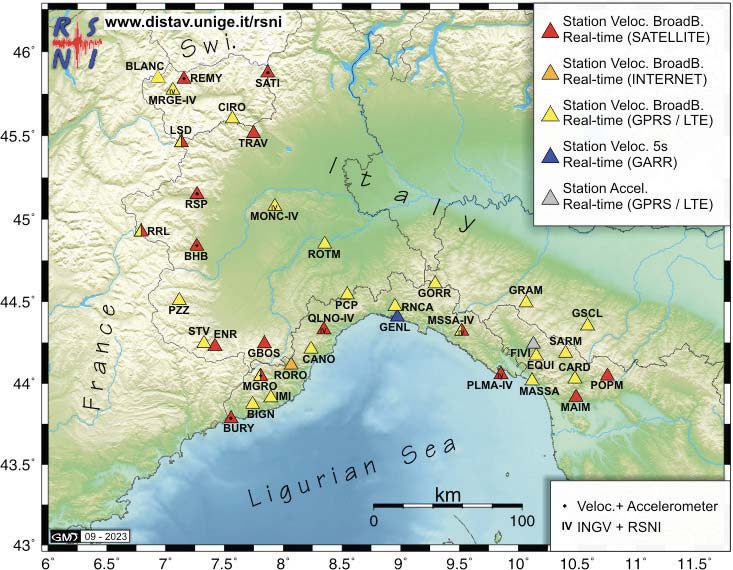
Alerts transmitted by the Regional Seismic Network of Northwestern Italy through nowtice utilize the integrated text-to-speech technology.
The personnel at the University of Genoa independently establish the messages to be transmitted, while the platform handles automatic phone calls to recipients and composes the message, which is then read aloud by an artificial voice.
This feature is also compatible with other voice communication channels, if necessary.
